
Researcher Autonomy
Keeping analytical judgment in your hands
Registration opens soon
View webinar details

Live webinar series · November–December 2026
Four sessions exploring researcher-led, AI-supported qualitative analysis. All webinars start at 18:00 CET. Registration opens soon. Select a webinar to read more about it.
Keeping analytical judgment in your hands
Registration opens soon
View webinar details
Developing analysis through sustained exchange
Registration opens soon
View webinar details
A hybrid intelligence approach
Registration opens soon
View webinar details
Examining evidence and strengthening interpretations
Registration opens soon
View webinar detailsWatch previous sessions on working with QualiDialog—from analysing interviews and open-ended survey responses to exploring methodological questions about research with AI.
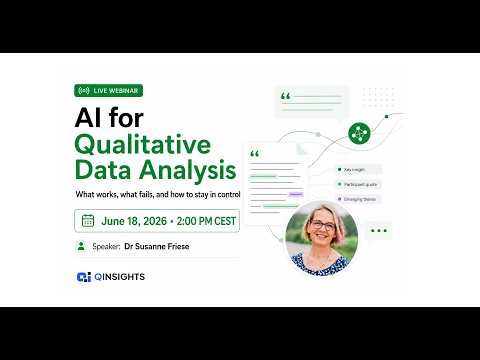
18 June 2026
How to use AI responsibly and methodologically soundly, with attention to traceability, limitations, and evidence-linked analysis.
Watch on YouTube ↗The webinar examines how researchers are using tools such as ChatGPT, Claude, Gemini and NotebookLM. These tools can be useful for brainstorming, editing and summarising, but they are not designed around the methodological requirements of qualitative analysis. Long or complex datasets can be fragmented, and important context may be lost as the model processes only parts of the material at a time.
Hallucination does not only mean inventing facts. AI can also smooth out differences between participants, over-generalise across cases, blend separate accounts or fill gaps with plausible explanations that are not supported by the data. The session discusses why these less obvious distortions are particularly difficult to notice when researchers move too quickly from uploaded material to conclusions.
AI should support the researcher rather than replace interpretation. A methodologically defensible workflow requires every proposed pattern or claim to remain connected to the original transcripts, field notes or documents. Source grounding allows researchers to inspect the evidence, challenge the AI’s reading and decide whether an interpretation is warranted.
QualiDialog is introduced as an environment built specifically for qualitative material. Researchers can explore topics, ask questions, compare perspectives and develop findings through dialogue while retaining access to the supporting source segments. The emphasis remains on researcher-led analysis rather than one-click automation.
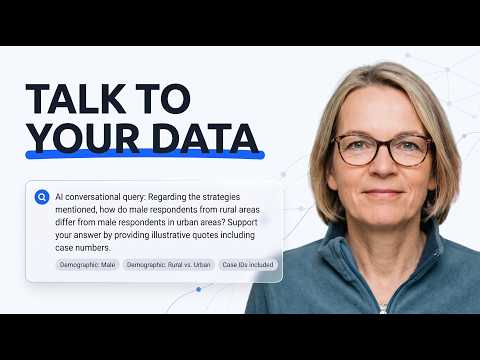
31 March 2026
An applied session on making sense of open-ended survey material while preserving context and access to the source evidence.
Watch on YouTube ↗The session shows how open-ended responses can be imported from a spreadsheet while keeping closed questions and respondent characteristics available as variables. This separation allows the text to be analysed qualitatively without losing the contextual information needed to compare groups or interpret individual responses.
Topic Analysis provides a first overview of what respondents discuss across the dataset. Rather than treating this output as a finished result, the webinar uses it to identify areas that deserve closer attention and to formulate more precise analytical questions.
The demonstration explores how views converge and differ across respondents and selected subgroups. Particular attention is given to tensions, exceptions and contrasting accounts that would disappear in a simple summary of the most frequent responses.
Focused questions are developed iteratively in conversation with the data. Each answer can lead to a follow-up, a comparison or a check for counterexamples. This supports a more analytical reading than asking the AI to produce a complete interpretation in a single prompt.
Suggested insights remain linked to the underlying survey statements so researchers can check what was said, by whom and in which context. The researcher remains responsible for deciding which patterns are meaningful and how they should be reported.
February 2026
A walkthrough from raw interview material to analytic stories using QualiDialog as an AI-assisted thinking partner.
Watch on YouTube ↗The webinar begins with the information QualiDialog needs before analysis: clearly structured transcripts, reliable speaker labels and a concise project description. The project context gives the AI assistant the background a human research assistant would also need when joining a study at the analysis stage.
Document summaries and Topic Analysis provide an initial orientation across the transcripts. These broad views help the researcher remember what is present in the material, identify promising areas of inquiry and decide where deeper analysis should begin.
The demonstration moves into Conversational Analysis with a manageable subset of interviews. Descriptive questions establish what participants have said before follow-up questions explore relationships, differences, explanations and alternative readings.
Responses are examined within and across interviews so that shared experiences can be considered alongside individual variation. Filters and comparisons make it possible to investigate whether an emerging pattern holds across relevant groups or depends on a particular context.
The final stage brings related findings together into broader analytical storylines. Supporting quotations remain available throughout, allowing the researcher to return to the original interviews, refine the interpretation and retain responsibility for the account that is ultimately presented.
15 July 2025
A live QualiDialog demonstration of qualitative analysis through conversation, including practical guidance for steering the AI assistant as an analytical collaborator.
Watch on YouTube ↗The webinar demonstrates how an AI-assisted qualitative project is set up and explored in QualiDialog. It shows how project context, prepared source material and a clear analytical focus give the AI assistant the information needed to work with the researcher rather than produce a detached generic summary.
The worked example uses ten YouTube videos in which PhD students discuss difficulties, coping strategies and advice. Topic Analysis provides an initial map of the material, including research practices, motivation, self-reliance, community, supervisor relationships, work–life balance and mental and physical well-being.
The initial overview is treated as a starting point. The researcher selects topics that matter for the project and develops questions to explore them further, rather than trying to analyse every possible topic with equal depth.
Conversational Analysis is used to ask focused questions, inspect the response and decide what to pursue next. Follow-ups clarify concepts, compare experiences and test whether an emerging interpretation is supported across the selected material.
The demonstration illustrates how AI can reduce the time needed to retrieve and organise relevant material. Speed does not make the analysis automatic: the researcher still determines the questions, evaluates the answers, checks the supporting evidence and constructs the final interpretation.
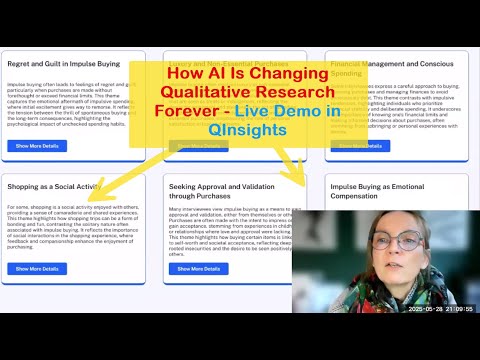
27 May 2025
The methodological foundations of conversational analysis with AI and their practical implementation in QualiDialog.
Watch on YouTube ↗The webinar questions the assumption that qualitative material must first be segmented and labelled before it can be analysed. Large language models create the possibility of working through questions and answers instead, while the researcher retains responsibility for the analytical direction.
The method begins with familiarisation and an initial map of the material. The researcher then selects a topic, prepares several analytical questions, works through them in dialogue with the AI and synthesises the developing findings. A further stage can connect those findings to theoretical concepts or explanatory models.
Rather than asking the model to process an entire project at once, the session recommends beginning with a manageable group of interviews or documents. Smaller subsets support more detailed answers and make it easier to compare relevant cases before testing the analysis against further material.
Each response is treated as part of an ongoing analytical exchange. Researchers can request clarification, examine differences, search for negative cases, ask for alternative explanations and refine the focus as their understanding develops.
The demonstration shows how QualiDialog supports this workflow through project context, variables, focused retrieval and direct links to source segments. The method supplies the analytical logic; the software helps the researcher carry it out transparently and efficiently.
April 2025
Why general chatbots fall short for qualitative research and how structured human–AI collaboration supports deeper analysis.
Watch on YouTube ↗The session explains why uploading a collection of transcripts and requesting a complete analysis often produces broad, superficial answers. General-purpose chatbots are designed to summarise, and their responses can hide which parts of the dataset were retrieved or overlooked.
Instead of beginning by tagging segments, the webinar proposes exploring qualitative material through a structured sequence of questions. The researcher formulates the focus, assesses each response and uses follow-up questions to deepen or redirect the analysis.
Early questions establish what participants say about a selected topic. Later questions examine differences, relationships, context and possible explanations. This gradual development reduces the risk of moving prematurely from raw material to an abstract conclusion.
A focused selection of interviews allows the model to provide more detailed answers and makes case comparison more manageable. Additional interviews or groups can then be introduced to test, extend or challenge the emerging understanding.
QualiDialog is presented as a way to conduct this dialogue while retaining links to the data. The AI assists with retrieval, comparison and synthesis; the researcher remains responsible for evaluating the evidence and deciding what can legitimately be claimed.
From the archive
These recordings document the ideas and early experiments from which QualiDialog developed. The 2023 presentation predates the application and captures the starting point: reconsidering the role of coding and exploring how generative AI might support a different approach to qualitative analysis. The October 2024 webinar introduces QInsights, now QualiDialog, shortly after its initial launch. The December 2025 anniversary session looks back at its first year and introduces version 1.5. The interface and some workflows are no longer current, but the methodological questions and several core ideas remain relevant.
9 December 2025
A look back at the first year of QInsights, now QualiDialog, with lessons from AI-assisted analysis and a demonstration of the workflow and features introduced in version 1.5.
Watch on YouTube ↗This anniversary session reflects on the first year of QInsights in public use. It considers what researchers found valuable in a conversational approach, where clearer guidance was needed and how practical experience shaped the development of the platform.
The webinar introduces the revised interface and analysis workflow released with version 1.5. The changes are shown in the context of an actual project rather than as isolated product features, illustrating how researchers can move between orientation, focused exploration and the organisation of developing findings.
A worked example demonstrates how AI can help surface common positions while also drawing attention to disagreement, nuance and contradictions. The purpose is not to collapse the dataset into a single summary, but to understand how different perspectives relate to one another.
The session reinforces the value of working through a sequence of questions. Researchers can respond to an answer, test an emerging interpretation, request alternative readings and return to specific cases rather than accepting the first output as the result.
Throughout the demonstration, findings remain connected to source material. QInsights can organise and retrieve evidence, but the researcher decides what the evidence means, which conclusions are defensible and how uncertainty or disagreement should be represented.

29 October 2024
The first webinar introducing QInsights, now QualiDialog. It demonstrates how to prepare different forms of qualitative material and analyse them through conversational and grid-based approaches.
Watch on YouTube ↗The webinar begins with a question many researchers still ask: why does an AI-assisted qualitative analysis tool need to be cloud-based? It explains how QInsights uses large language models through Microsoft Azure, with data processed on European servers, protected within the platform’s encrypted environment and not used to train the underlying models.
The early QInsights workflow is demonstrated with interview transcripts in Word and PDF format, audio recordings and semi-structured Excel data. The session explains how speaker labels allow transcripts to be processed systematically, how uploaded audio is transcribed and assigned to speakers, and how spreadsheet columns can be designated as variables or open-ended material for analysis.
A short project description gives the model relevant context without reproducing an entire proposal or paper. Document summaries and the feature then called Theme Analysis provide an initial map of the material. The webinar also discusses why these broad analyses should be used selectively before moving into more focused questions.
Using interviews with female academic leaders, the demonstration shows why it is often more productive to work with a focused subset than to ask the model to analyse every interview at once. Questions about definitions of success are developed iteratively, connected to biographical material and compared with management literature. Grid Analysis provides a respondent-by-respondent overview supported by quotations.
This recording captures QInsights in its first public iteration. Features such as improved chat exports, named and saved analysis sessions, saved grids and a prompt library were still being developed or considered. The interface has changed substantially since then, but several of the methodological ideas shown here continue to shape the current platform.

December 2023
A foundational discussion of the history and purpose of coding and whether generative AI enables analysis without encoding the material first.
Watch on YouTube ↗The presentation returns to the historical reasons for coding qualitative material. Before digital search and retrieval, researchers needed a practical way to reduce, organise and locate passages across extensive collections of text. Coding became both a technical solution and, over time, a widely accepted marker of systematic analysis.
Codes help researchers retrieve related material, compare cases and build categories. At the same time, segmenting and labelling data can separate statements from their broader context and encourage analysis to follow the structure of the code system rather than the developing research question.
Large language models introduce a different way of accessing qualitative material: researchers may be able to ask questions directly and receive a synthesis of relevant passages without first encoding the dataset. In 2023 this was still a methodological proposition rather than an implemented QualiDialog workflow.
The webinar considers what may be lost when the retrieval and synthesis process is handled by an opaque model. Reliability, traceability, context, researcher familiarity with the data and the risk of premature interpretation remain central concerns.
This recording documents the ideas that preceded the application. Several principles visible in the current platform are already present: analysis through dialogue, the need to remain close to the source material and the view that AI should extend the researcher’s analytical capacity rather than take over interpretation.