Towards a four-step workflow for conversational analysis
A 4-Step Workflow for AI-Supported Analysis 💡
As I shared in last week's newsletter, I’ve been working on a book chapter about using AI for qualitative content analysis. While writing, I also took the opportunity to refine my own approach Conversational Analysis with AI and shape it into something more structured and easy to follow.
In today’s newsletter, I’m excited to share a simple breakdown of the process with you. And if you're curious to see it in action, there’s a webinar on April 4th where I’ll walk you through it (details at the end ⬇️).
But first… let me officially introduce the new abbreviation: Conversational Analysis with AI 👉 CAAI
CA to the power of.... get it? Let me know what you think.
If you’ve been following my work, you’ll know I’m not a fan of “push-button” AI replacing researchers. AI shouldn’t automate our thinking—it should enhance it. That’s the idea behind CAAI — a collaborative, iterative way to explore your data in conversation with an AI assistant.
Here’s how it works:
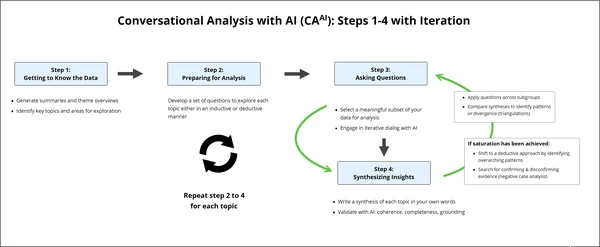
🔹 Step 1: Get to Know Your Data Start by asking the AI to summarize your documents or pull out potential themes. This gives you a bird’s-eye view of what’s going on and helps you identify key topics and potential areas for deeper exploration.
🔹 Step 2: Prepare Your Questions Once you’ve picked a topic to start your analysis with, plan your questions for the AI. You can even brainstorm with it—ask for help phrasing your questions clearly and creatively. But you stay in the driver’s seat: you choose what’s most relevant for your research.
🔹 Step 3: Dive In Choose a focused set of documents—maybe a single group of interviews—and start your dialogue. Ask your prepared questions, explore what the AI brings back, and follow up with more questions. You can go inductively (let patterns emerge) or deductively (test your ideas). Either way, you’re guiding the process.
🔹 Step 4: Make Sense of It All Now it's your turn. Don’t stop at the AI’s answers—reflect, interpret, and write your own synthesis. Then, check your thinking: you can even ask the AI to review your summary and see if anything’s missing or unclear. 🌀 This isn’t a one-and-done process—you’ll loop back, test ideas across different subgroups, and refine your insights step by step. With each round, your understanding deepens, and your findings get stronger.
Here is a first attempt to visualize the process - keep in mind this is all work I've also made a first attempt at visualizing the process. It's still a work in progress, so I’d love your feedback!
There’s also an extended version of the workflow that includes steps for reliability checks and validation—but that’s best saved for the webinar discussion.