Using ChatGPT for interview analysis? Read this first
Many researchers now upload interview transcripts into ChatGPT or Claude and ask analytic questions about the data.
From the outside, this looks straightforward. You upload your transcripts, type a question, and get an answer. And to be fair, the answer can sound very convincing. You can ask about themes, contradictions, subgroup differences, or counterevidence, and the system often responds as if it has worked through the dataset in a solid analytic way.
But what matters is not only the question you ask. What matters is what happens inside the system when that answer is produced.
This is where the difference between a general-purpose chatbot and a purpose-built system for qualitative analysis begins.
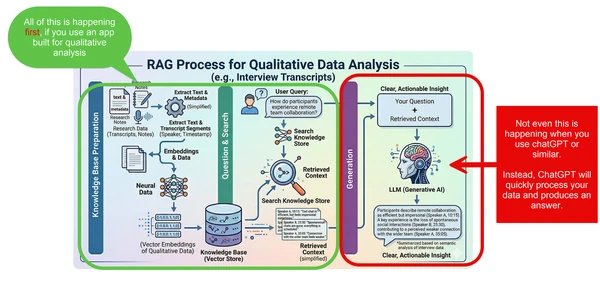
When you upload transcripts into a general chatbot, the file is parsed into text the model can process. The model then answers your question based on the text available in its context window. If the dataset fits, the model may indeed have access to all of it. But having access to the full text is not the same as performing an explicit search across the data.
A chatbot typically does not first retrieve the most relevant passages from the dataset and then build its answer from those results. Instead, it works by attending across the text in context and generating the most likely continuation based on your prompt, the available text, and its learned language patterns.
In other words, it answers from data that is present in context, not from a separate retrieval process over indexed evidence.
That means the path from data to answer remains largely implicit.
Even if the output is strong, you usually cannot see clearly how the model arrived there. You do not know which passages carried the most weight, whether all relevant parts of the dataset were considered systematically, or which material may have been ignored or underused. The answer may still be useful, but the analytic route is opaque.
A RAG-based system works differently.
In a RAG system, the uploaded transcripts are broken into segments and stored in a searchable index. When you ask a question, the system first retrieves the most relevant passages from the dataset. Only then are those retrieved segments passed to the language model to generate an answer. That changes the process in an important way.
The answer is no longer based mainly on the model’s diffuse attention over one large block of text. It is based on a prior retrieval step that selects relevant evidence from the dataset. The path from question to answer becomes more explicit.
The system can be designed to show which passages were retrieved and used. And that makes it much easier to move back from interpretation to source data.
From the surface, both systems may look similar. You ask a question. You get a fluent answer.
Inside, they are not doing the same thing.
A general chatbot answers from data-in-context. A RAG system answers from data-it-has-retrieved.
That may sound like a technical detail. It is not. It affects how grounded the answer is, how easy it is to validate, and how much confidence you can have in the link between conclusion and source material.
This is why using a general chatbot for qualitative analysis is more problematic than it first appears. The problem is not that you cannot ask good questions. You can. The problem is that the answer may look methodologically stronger than the underlying process actually is.
And this is why we have built and continue to develop QInsights for qualitative researchers.
QInsights uses retrieval as part of the analytic process. It is designed to help you work with interview data in a way that stays connected to the source material, makes the path to an answer more transparent, and supports validation rather than leaving you with a polished response you simply have to trust.
If you are currently analysing data in ChatGPT or Claude, it is worth understanding this difference. On the surface, both approaches may seem similar. Under the hood, they are not.