
AI is great at summarising—but that is not all
AI is Great at Summarising—But That’s About It
We hear this a lot. And yes, it is true, large language models do condense text beautifully, but instead of stopping there, make use of this skill as the launch‑pad, not the landing strip.
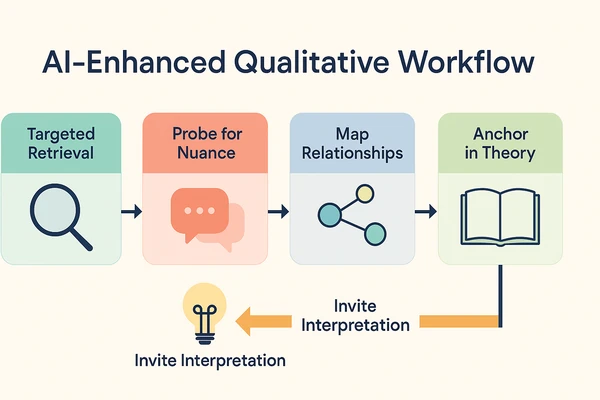
Below is a real excerpt from a recent analysis session with QInsights
qinsights.ai/ on impulse buying (respondents: Betina, Steve, Jo) that shows how deeper questioning converts a bland summary engine into a collaborative co‑analyst.
1 | Start with targeted retrieval Prompt: “What motivations do respondents give for making purchases they later considered unnecessary or excessive?”
AI return (abridged): Feeling “fed up” and seeking a lift (Betina). Keeping up appearances—“out to impress” (Steve, p. 1). Pure playfulness and “the pleasure of seeing nice things” (Jo, p. 3).
At this stage the model is still aggregating, but notice how it already surfaces distinct motivational clusters rather than a single undifferentiated blob.
2 | Probe for nuance Follow‑up: “Describe the emotional state before and after those purchases.”
Betina felt “fed up” beforehand; the buy delivered a short‑lived “excited” high, sometimes followed by regret when items “weren’t as good as expected” (Betina, p. 5).
Steve oscillated between boredom → purchase → feeling “stupid” and “feeble” (p. 10).
Jo used shopping to break routine; the hunt itself lifted her mood. These micro‑contrasts set the stage for richer theorising: different mechanisms, different intervention levers (p. 7)
3 | Map relationships Prompt: “In what ways do respondents link buying decisions to social expectations or external validation?”
Betina buys to “turn heads” and feel “as good as anyone else.”
Steve’s big‑car purchase is armour against perceived failure—“I nurture that impression.” (p. 2)
Jo’s link to validation is weaker; her focus is inner, not outward. Here the model is no longer summarising; it is connecting dots across interviews so you can sketch preliminary affinity maps in minutes instead of hours.
4 | Invite interpretation Prompt: “Highlight unique angles each respondent brings—where do their stories diverge?”
Respondent Distinctive lens Example quote Betina Status‑seeking spotlight “I like to think … people will turn round and look” (p. 4)
Steve
Fear‑of‑failure avoidance “I’m probably frightened of being a failure” (p. 12) Jo
Playful mood‑shift “There was impulse buying … I enjoy wearing [those clothes]” (p. 7)
The model’s role here is hypothesis generation: it proposes that Betina’s spending is upward‑comparison, Steve’s is defensive, Jo’s is experiential. It’s still your job to test those claims, but the heavy lifting of pattern spotting is done.
5 | Anchor in theory Feed the model the frameworks you care about: “Relate these motives to symbolic self‑completion (Wicklund & Gollwitzer) and mood‑repair theory.”
Within seconds the AI weaves direct quotes into academic constructs, giving you draft analytic memos ready for refinement.
Take‑away Summaries are just the overture. By iterating with precise, theory‑infused prompts you can make AI:
• Retrieve relevant slices of data. • Disaggregate motivations and emotional arcs. • Connect respondent narratives to social forces. • Hypothesise divergent perspectives. • Translate insights into theoretical language.
Treat it like a junior co‑analyst—capable, tireless, but always needing your critical eye—and you’ll turn raw transcripts into publishable insights faster than any manual workflow.