
Should we allow an AI assistant to interpret our data?
This question keeps appearing in discussions about AI-assisted qualitative analysis. One common answer is: AI may summarise, retrieve, question or challenge but interpretation must remain with the human researcher.
I am not sure that this boundary is as clear, or as reassuring, as it sounds. The discussion reminds of the book by Lewis: The Undoing Project, the story of Daniel Kahneman and Amos Tversky and their research on human judgment and decision-making. Much of their work showed that human judgment is systematically influenced by cognitive shortcuts. Among their findings:
Representativeness: We judge probability by how much something resembles our mental prototype rather than by statistical likelihood.
Availability: Things that come easily to mind can seem more common or probable than they really are.
Anchoring: An initial number or piece of information influences later judgments, even when it should not.
Base-rate neglect: A compelling individual case can make us disregard broader statistical information.
Their research was not specifically about qualitative analysis. But it raises some questions related to the current AI debate. If human judgment is itself vulnerable to anchoring, salience, framing and premature pattern recognition, then saying “interpretation must remain human” cannot by itself be the methodological safeguard.
This does not mean that an LLM “understands” data in the same way a researcher does. Nor does it mean that we should hand interpretation over to AI. I think we are drawing the boundary in the wrong place. A counterargument already presupposes a particular reading of the material. A question can imply an interpretation. Selecting something as surprising, contradictory or worthy of further attention is not analytically neutral.
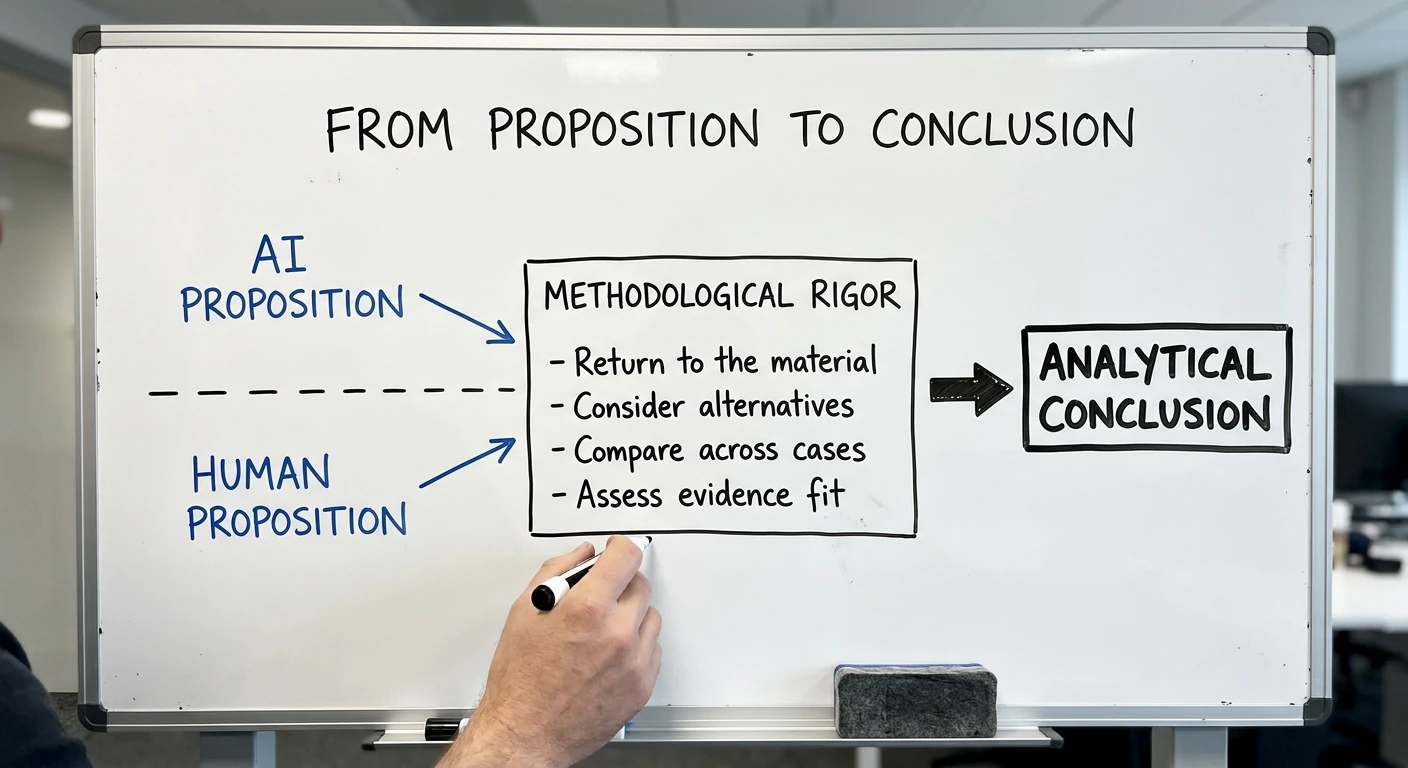
So for me, the relevant distinction is not between human interpretation and AI interpretation. It is between an interpretive proposition and an analytical conclusion. An AI assistant can propose a reading, identify a possible relationship, suggest an explanation or formulate a hypothesis. So can a human researcher. Neither should become an analytical conclusion simply because of who produced it. What matters is what happens next:
Do we return to the material? Consider alternative explanations? Compare across cases? Examine how well the interpretation is supported? Revise it when the evidence does not fit?
This is also why I think methodological competence becomes more important as AI becomes more capable. A language model can produce something that sounds like qualitative analysis remarkably easily. The methodological task is to determine whether it actually holds.
So perhaps the question is not: Should we allow AI to interpret our data?
But: What do we require before any interpretation, be it human or AI-generated, earns the status of an analytical conclusion?